What Is Plexi?
An interview with the guy who built a terminal app he can't stop using
This is an interview. I built Plexi. Someone had questions.
What is Plexi — in the way you’d explain it if someone asked you at a bar?
My attempt at a tool that helps you use a computer at the speed of thought.
When you say “speed of thought,” what does that actually feel like? What’s happening on your screen when you’re in that mode?
Everyone knows that a keyboard shortcut is faster than moving your mouse up to the menu bar, clicking the dropdown, and clicking undo. But have you ever considered collections of shortcuts? Being faster than a single shortcut — one shortcut can do ten things depending on a bunch of different conditions. What if the surface area of potential impact spread across every file on your computer, cutting down the time you spend fighting the interface to practically zero? So that nearly every moment of your time at the computer is actually taking action on things as fast as they’re occurring to you.
If you need to see a piece of information, it’s one tap away. If you need to input a piece of information, it’s one tap away. If something is waiting on your attention, it can surface as a notification that’s one key away. It can ask you a yes-or-no question — whether or not you’re available for a call — and you can respond.
You keep saying “one tap.” Is that literal? Are we talking keyboard shortcuts, voice, something else — what’s the actual interface?
It’s a command line on steroids that I’m continually trying to expand the surface area of, so that it can contain the full scope of your interactions and you can leverage all of that data yourself. The way to build systems that help you never forget anything is to make sure that you never have to remember to write it down — just live inside this ecosystem that works exactly how you want.
At its core it’s a command line, but that’s not saying a lot, because at every app’s core it’s a command line. At the end of the day, I attempted to capture the pleasure of a well-riced Linux in something more accessible — a self-contained Mac app. [NOTE - earlier in this answer you say “can also run on Linux” — cut it here since you’re Mac-only for now, or add nuance if Linux support is genuinely planned]
I drive it with mostly voice and spatial navigation, but you can use pure text-based navigation. You could drive it with a GameCube controller if you wanted. Depending on the work you’re doing, you can talk through most of it. Anything you want to do by hand, you can have an AI build you the interface that lets you do that exact thing, in a focused realm that can be highly leveraged.
For example, if your thing is knowing how the timing of video editing works — if you just know what a good video feels like — then you should be doing that and only that, and everything else is baggage. You should never be dragging around files, backing up footage, transferring files, renaming files, dragging files into an interface, or doing basic media management and timeline arrangement. You should just be sitting there making videos feel good. The rest doesn’t need your artistic touch. It’s just a waste of your time.
I figured: what would it look like to use a computer in a way that would waste zero time and get better at not wasting your time the more you use it?
You said “the pleasure of a well-riced Linux in a self-contained Mac app.” For someone who has no idea what ricing a Linux setup means — what are you actually talking about, and why does it matter?
For anyone completely unaware, Linux is the third major operating system in popularity, behind Windows and macOS. [CLAIM - desktop market share; StatCounter typically shows Linux ~4%, but Chrome OS (also Linux) complicates this — worth verifying before publishing] It’s completely free and community-maintained, but it has a culture of being a bit finicky at times and just not having the polish of an enterprise operating system — which, to call Windows anything close to polished is hilarious.
Point is, it’s community-driven, and anyone zany enough to use Linux in the first place probably knows their way around a computer and is probably doing it because the current operating systems didn’t work for them. That’s probably because they’re not the average user. And that’s the interesting thing about technology: no one’s the average user. The fact that there are two and a half major computer ecosystems at this point is laughable. Most of that is because making something show up on a screen in the first place is really complicated, but once it’s there, you should theoretically be able to do whatever you want. For the longest time, that freedom was foregone by mainstream technology — and obviously for good reason. If you truly want your computer to do whatever you want, people who just don’t give a hoot would be drowning in complexity, and you’d be building stuff that most people don’t use.
[REWRITE OPTION: “For the longest time, mainstream technology traded that freedom away — and for good reason. If you made a computer that truly did whatever you wanted, anyone who didn’t want to think about it would drown in complexity.”]
That’s why you have this community of people who are tickled by the idea that a computer can be whatever you want, and they don’t mind DIYing it sometimes. For the bold adventurers who go down that path, they usually end up with a system of interacting with a computer that is so uniquely theirs. It has some similarities — we converge and diverge in different ways — but you end up with a system that is so uniquely yours that sitting down at any other computer just feels like you’re an idiot. You’re like, “Why is this hard? This is so hard!”
An actual riced Linux setup is basically when people are like, “Wouldn’t it be cool if when apps minimized, they went like this?” or “Wouldn’t it be cool if my background was different depending on the weather and time of day?” or “Wouldn’t it be cool if my background was a tree and my notifications were like apples on that tree?” or “Wouldn’t it be cool if my files were like leaves on a tree and my folders were like branches and I could zoom around a 3D sculpture?” That’s all possible today, and some people have done it. It’s just not everyone’s jam, so big companies haven’t prioritized it. But it’s all possible, and it’s even more possible now.
Something big happened: now everyone has the technical know-how, and I know this for a fact because I was able to do it. My dyslexic ass was able to write 100,000 lines of code that I can’t live without. [CLAIM - line count; worth a quick cloc or wc -l if you want this to be a concrete, accurate number] That’s because the technology has gotten better. Everyone’s an expert now, so everyone can theoretically have what the experts got to have — the people who took the time to build their own system. We can be building our own apps. The problem is it’s still kind of out of reach and still looks weird. It still looks like vibe coding platforms where you go to a website and make an app, workshop it until it’s workable, put it on the app store, and it’s just another to-do list. Even that is so clunky and outdated at this point, because you might not need that app for more than a week. What we need is a system of building apps the moment you need them, in the place you’re going to use them.
Can you give me a concrete example of something you do in Plexi in one move that takes five steps on a normal Mac?
Opening a file explorer should be easy. I should be able to have a good video viewing experience without having to open an entire video player app. You should be able to funnel your notifications through a single channel, agnostic of the system it came from. There’s no reason we can’t see our emails and our texts and our reminders and our to-dos in the same stream, sorted by priority. There’s no reason we can’t actually do that. It just needs the plumbing.
[NOTE - the question asked for one concrete “one move vs five steps” example. These are vision statements, not a demonstration. Even one specific keybind + what it replaces would land harder. Optional to address, but if you leave it as-is, consider softening the question so it doesn’t set up an expectation you don’t fully deliver.]
It just needed someone to go through and rework the fundamentals, because up until today, software has been made for human users and then we’re just now duct-taping AI to the corner of it. We slap it on the side and call it an AI product, but it’s not the entire approach to software. How we design software needs to change. I think Plexi is my vision of that future.
What does software look like when it’s designed for humans AND AI from the ground up? What’s actually different?
Narrower channels with more easily accessible boundaries. If all of your apps can talk to each other, the distance between data that’s available — how much you spent on ads, what the S&P 500 is — and data that’s accessible to you in a way you prefer to see it, that distance should be zero. Maybe you want to see your macros on a pie chart front and center with one key press. You should be able to do that. But that comes down to a narrow channel where nearly every bit of information about you flows. You have to own it outright because of the sensitivity, but once you do, the advantages just fall out.
[REWRITE OPTION for “the advantages just fall out”: “but once you do, the advantages become obvious.”]
Instead of you trying to think of things you can ask AI to do for you, you tell it what the actual point is, and it’ll just let you know when it needs your expertise. We should never be sitting there looking at a computer trying to figure out what to get it to do. It should be constructing researched, highly educated questions that are blocked on your insights, opinion, or approval.
That’s an example of how software is different. Not a dead interface that just waits for you to drag the mouse around before it does anything, but an interface that’s alive and actively working on things at the same time that you are. In a way that feels most natural and flow-prone for you, for the particular individual, because everybody is different.
Who is this for right now? Today, May 2026 — who downloads Plexi and gets the most out of it?
The optimistic answer is everyone, but the realistic answer today is people who either already live in this world where they know how agent collaboration works, or anyone who has tried or is interested in trying vibe coding and might be curious to know what it would be like to vibe compute.
One of my goals was to create an app development surface that’s just seamless, so that even the most affordable models can one-shot an interface. So that anybody can create something close to their own Photoshop, their own Premiere Pro, their own Ableton, their own text editor, their own Obsidian, their own games. I wanted to make that process as collaborative and forgiving to the AI-agent collaboration paradigm as possible, and I think I have every indication that I’m on that path. I’ve seen the light of the dawn, and I have the screen time to prove it.
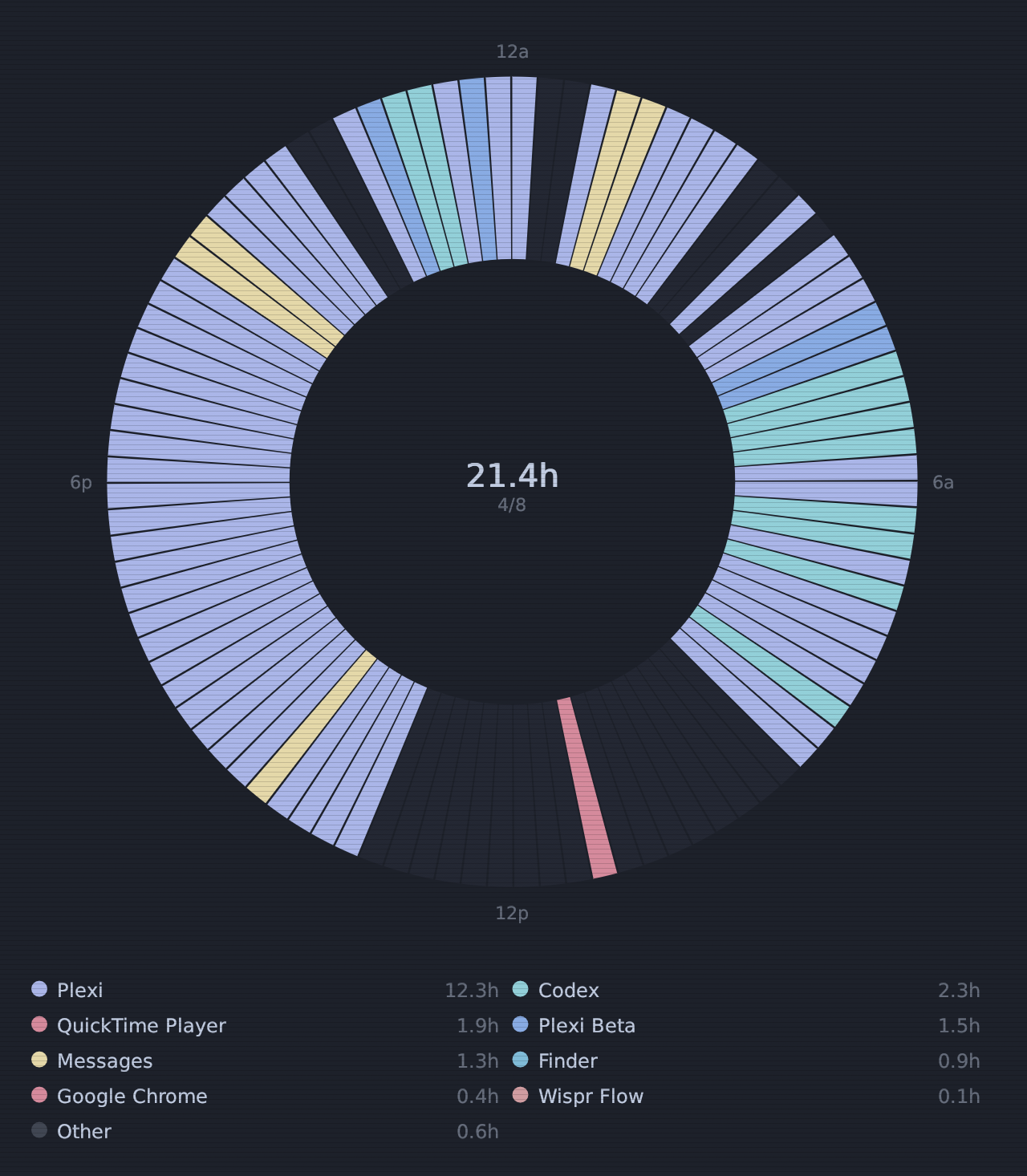
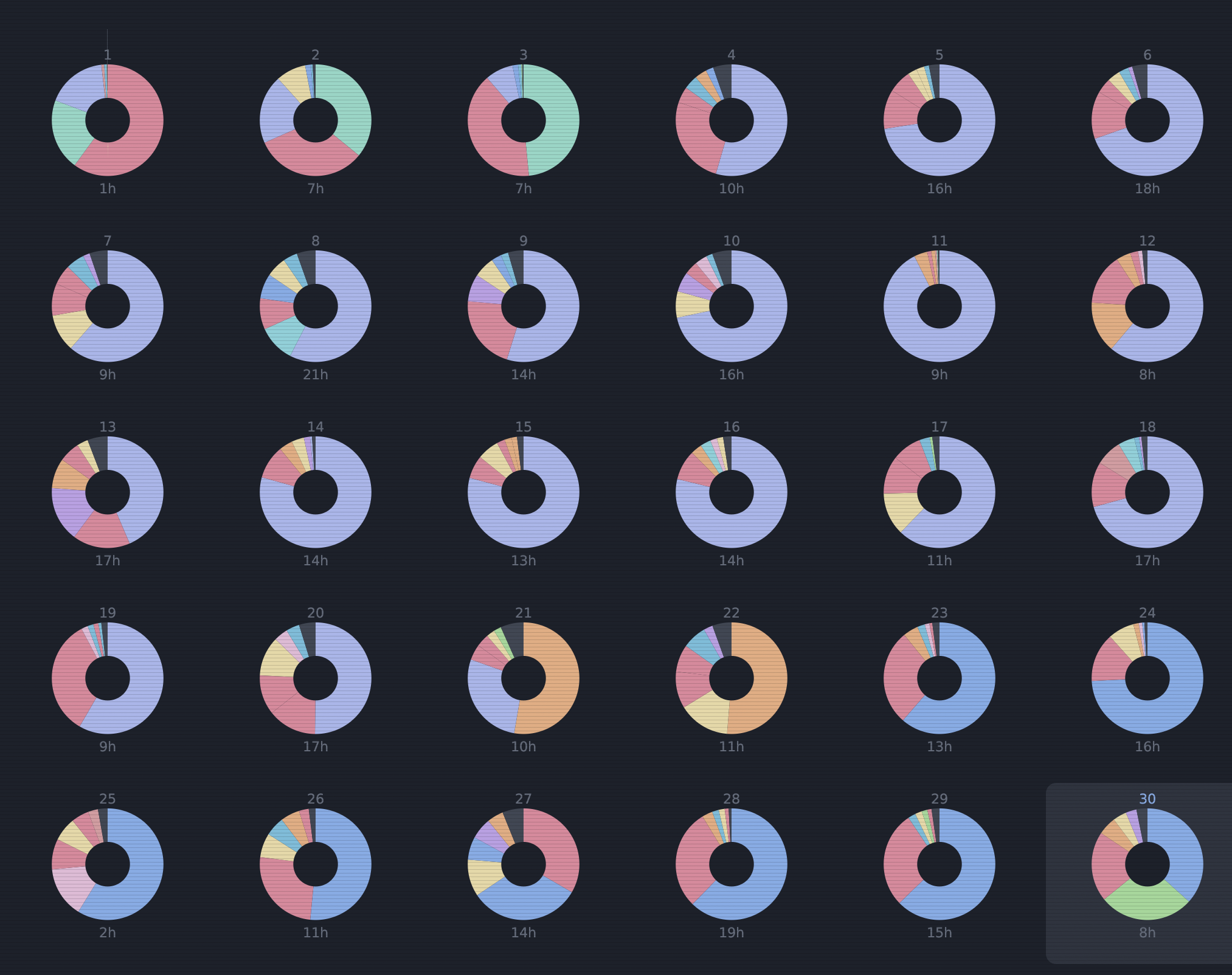
You have less than a year of actual dev experience. How does someone with less than a year of experience end up with 100,000 lines of code they can’t live without? What’s the honest answer?
A profound love of technology mixed with a few AI subscriptions is a dangerous combination. I’ve felt so estranged from technology my whole life and didn’t even think I was invited to inquire, because the distance between the idea and the execution was just so large. Watching AI improve, improving my ability to interact with it, has resulted in a feeling of limitlessness — which begins to compound when you’re using it to help you make tools that appeal so narrowly to your specific use case. A tool that you always wished would exist, but no one would ever build because it’s so specific to you. Now anybody can do that, but today it looks like using a vibe coding platform or downloading Claude Code.
Sure, that is what it looks like today. But the open-source model landscape has already been validated. GPU prices are going to come way down, and you’re going to be able to have your own AI that never tries to sell you anything. When you do, it’s going to be really helpful for you to be able to give it all the information it needs and for it to be able to interact with you in a way that makes sense to you. This is me getting a head start on that, I guess.
I imagine embedding Plexi into wearable technology. [NOTE - this line is hanging. It either needs a sentence or two of expansion (what does that look like? why does it matter here?) or it should be cut. As a one-liner it reads like a thought that got away.]
You said you felt “estranged from technology” and “didn’t even think you were invited to inquire.” What made you feel uninvited?
It’s clunky! The process of interacting with a computer required such picture-perfect precision when typing into a command line interface. You just had to be meticulous and patient. And this entire article is dictated — that’s a monster of a difference. Not only that, but you could send a command to AI skipping every other word, and half the time it’s still going to do the right thing.
You’re dyslexic, you just dictated this entire interview, and you built a 100,000-line app. Is Plexi an accessibility tool? Do you think of it that way?
I think I do. My mom has been trying to write a book. She said that dictating her thoughts to ChatGPT and having it help her rearrange the sentences and then email her the pages was huge. As much of an advantage as that might be to someone like her — who’s like me, who wouldn’t have the time to sit down and type these things out — it’s actually helping her progress on this dream she’s always had.
That got me thinking. [NOTE - “that’s a pretty large leap” — leap from what to what? The connection between your mom’s book and your next thought (owning your own AI) is slightly implicit. One bridging sentence would help.] I have the suspicion we can go further. I have this vision that you’re in a position to say something — you should be able to have that thing go wherever it needs to go and move the needle on whatever project it’s related to. We have the technology to do that no matter where you are, no matter what you’re doing. In line at the carnival or at the dentist — we could all be taking action on these things. It’s just trapped behind our clunky first era of technology, but it’s time to usher in the next.
I think I could increase everyone’s speed of interacting with technology probably a hundred X. So much so that the technology just dissolves, if you want it to. It just does whatever you want — that’s essentially what I’m saying. If you want to dissolve it, it can. If you want it to show you eight windows of all the projects you have going, what they’re stuck on, and what needs to happen next on each of them in one view — and your credit card doesn’t work to buy coffee until you take an action on one of them — if you want that, you can have it. We live there already. There’s no missing technology for that. It just needs to be put in one place and made accessible.
That’s what I’m attempting to do here. To do it, and then — best case scenario — just hand it to people. So we can collectively own our own infrastructure that works exactly the way we want it, down to the individual.
Someone reads this interview and thinks “OK, I’m curious.” What do they do?
You can download it from here. You can hop on the GitHub. If it wasn’t obvious, I would like to keep this app free and completely community-driven. If you do see yourself getting value out of this and want to help me finish adding all the features, please consider becoming a sponsor.